Case study · Open source
EdgeSync
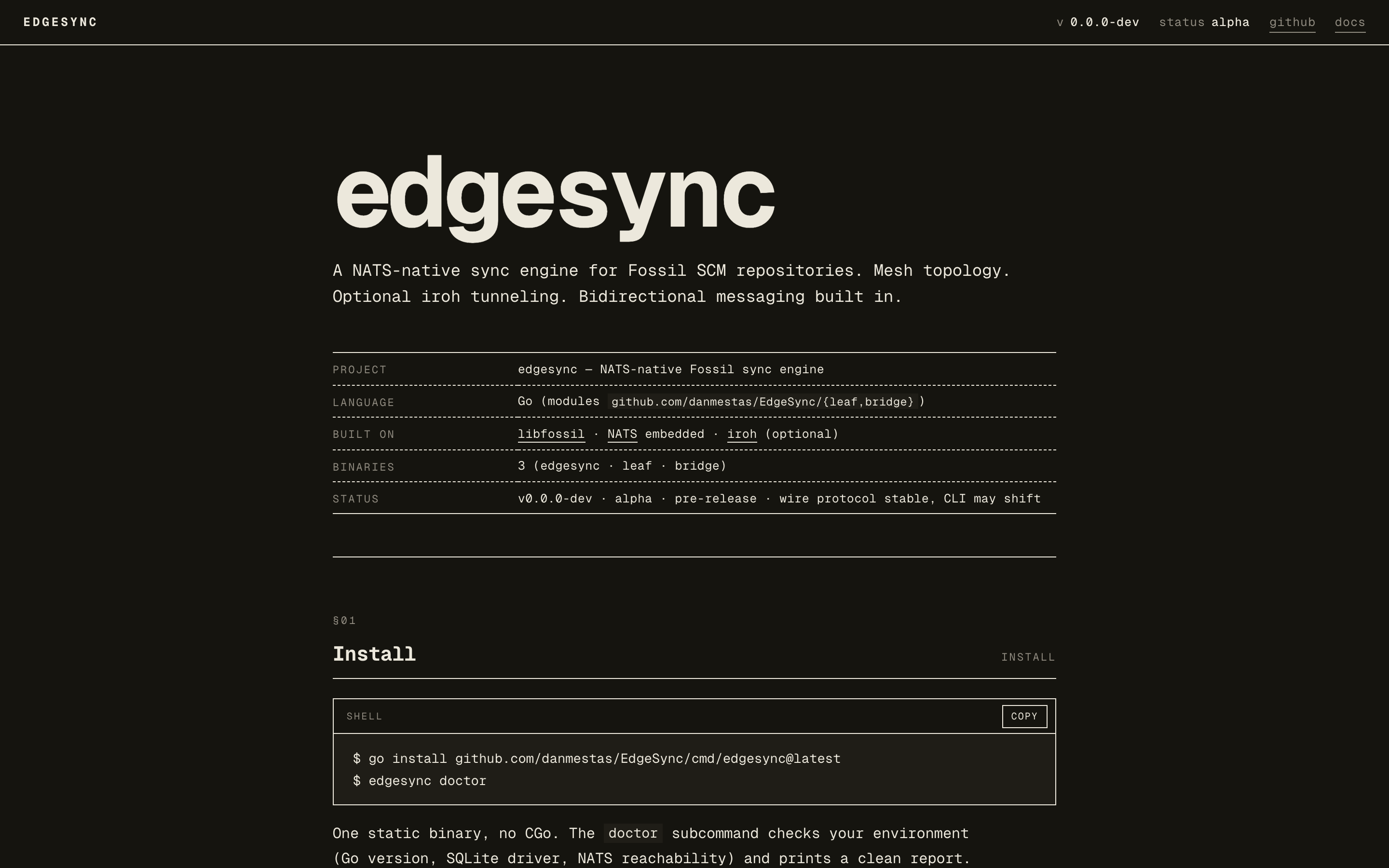
A NATS-native sync engine for Fossil SCM repositories. Every leaf is both client and server. Optional iroh tunneling for two leaves behind separate NATs. A bidirectional notify channel runs on the same mesh for human-in-the-loop messaging.
Project
Mesh sync engine for Fossil
Engagement
Original protocol and daemon design
Status
Alpha · wire protocol stable
Overview
A mesh, not a central server.
EdgeSync swaps Fossil's HTTP /xfer protocol for NATS messaging. The leaf agent reads and writes .fossil files via libfossil and exchanges blobs with peer agents over an embedded NATS mesh.
There is no central server in the default topology — each agent runs its own NATS in-process and gossip happens leaf-to-leaf. Add a peer with one CLI flag.
Problem shapes
When the topology is the problem.
EdgeSync is the right tool when the network shape — not the feature set — is what is hard.
Many small repos at the edge.
Robotics fleets, retail kiosks, CDN nodes, on-prem appliances. New devices pair with one peer and converge from there.
Bidirectional messaging alongside sync.
Most VC stacks bolt chat or notifications on as a separate service. EdgeSync ships notify on the same NATS mesh.
Zero infrastructure.
Embedded NATS plus iroh transport means no broker, no central server, no relay. Two laptops on coffee-shop wifi sync directly.
Architecture
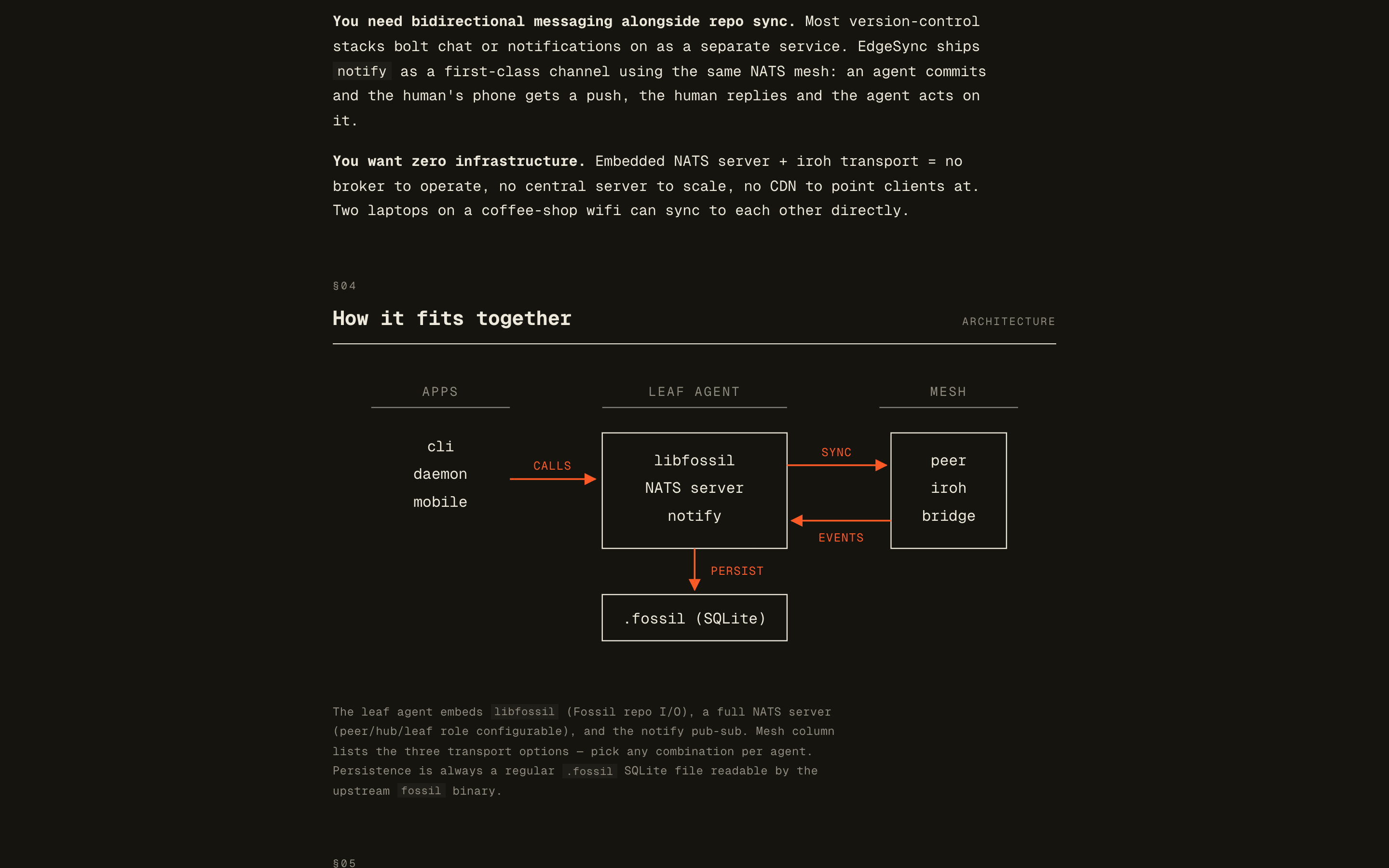
Leaf, hub, peer — pick any combination.
The leaf agent embeds libfossil, a full NATS server, and the notify pub-sub. Three transport options; pick any combination per agent.
Compared to neighbors
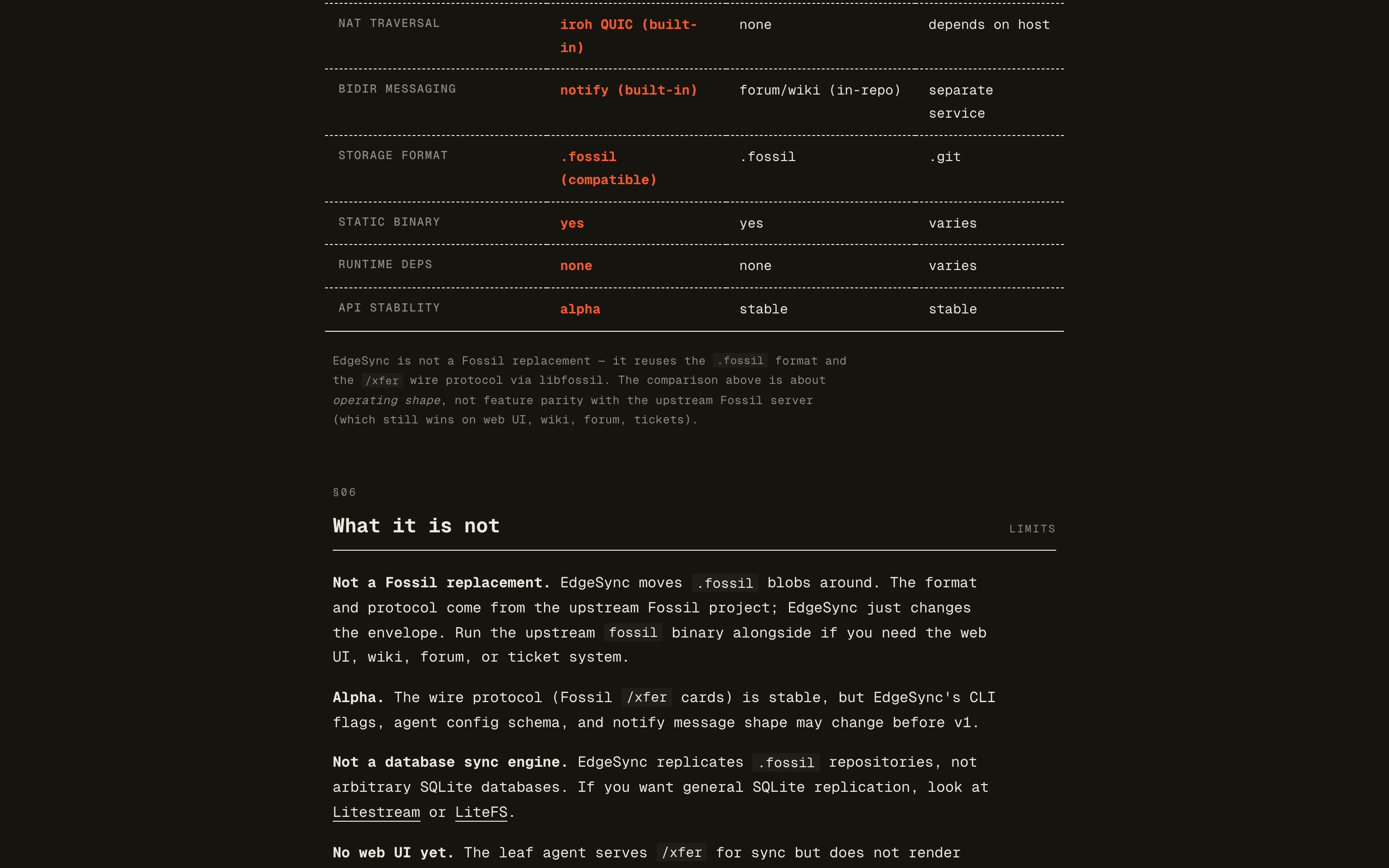
Operating shape, not feature parity.
EdgeSync is not a Fossil replacement — it reuses the .fossil format and the /xfer wire protocol via libfossil. The comparison is about operating shape: what runs, where, and what it costs to operate.
Specifications
Three binaries. One mesh.
Language
Go (no CGo)
Modules
EdgeSync/{leaf, bridge}
Built on
libfossil · NATS · iroh (optional)
Topology
Mesh — peer / hub / leaf
NAT traversal
iroh QUIC (built-in)
Bidir messaging
notify pub-sub channel
Storage
.fossil — readable by upstream
Status
v0.0.0-dev · alpha
Related
The mesh that ties it together.
EdgeSync distributes what libfossil stores and DagNats orchestrates — the substrate agents talk on, with humans on the same wire.
Reach out
Questions about the daemon, want to use it for something, or just want to compare notes — send me an email.
[email protected]